

CTV, February 07, 2026: Former U.S. president Joe Biden’s top national security official says that while Canada-U.S. relations will have to evolve given the current U.S. president’s trade actions and threats, a deep and sustained relationship moving forward is in both countries’ interests.
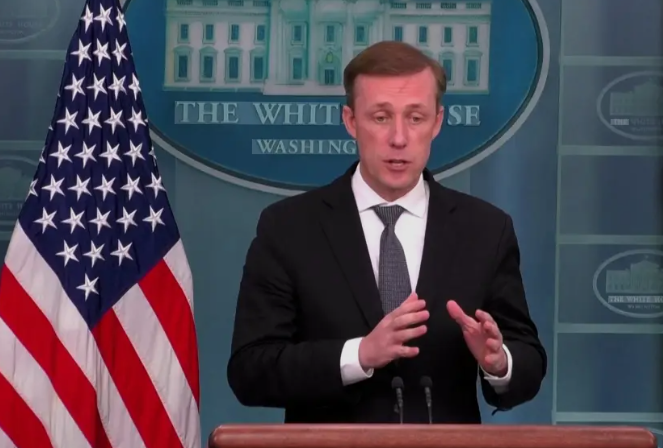
Jake Sullivan, who served as Biden’s national security advisor from 2021-2025, joined CTV’s Question Period for an interview reflecting on Prime Minister Mark Carney’s widely praised speech at the World Economic Forum, in which he eulogized the end of the U.S.-led international rules-based order.
“I do agree that we’ve reached the end of the post-Cold War era, and a new era is coming into view, but the shape of it, I think, is still contested and not entirely clear,” Sullivan told host Vassy Kapelos. “So, to that extent, I agree with the prime minister.”
“Where I disagree with the prime minister is that he effectively equated, not just under (U.S.) President (Donald) Trump, but for the long term, the United States and China,” Sullivan added. “Not in so many words, but that was the basic implication of his presentation.
Wang Yi, right, the director of the Communist Party’s Central Foreign Affairs Commission Office shakes hands with White House national security adviser Jake Sullivan, left, before their talk at Yanqi lake in Beijing, Tuesday, Aug. 27, 2024. (AP Photo/Ng Han Guan, Pool)
The long-time Democrat national security official said that because Canada and the U.S. have long-standing deep interests, communal ties and a “very long border,” it is imperative the two nations find a way to have a “deep and sustained relationship, even when we hit difficulties, like a president of the United States who claims Canada is the 51st state, or starts a trade war.”
Trump responded negatively to Carney’s Davos speech last month, declaring Ottawa should be grateful to Washington because “Canada lives because of the United States.”
In the days that followed, Trump decried Carney’s recent warming of relations with China, referred to the prime minister as “governor,” and threatened to impose a 100 per cent tariff on Canadian exports to the U.S. if “Canada makes a deal with China.”
“I want to be very clear, I think if I were a Canadian citizen, listening to the head of state of another country basically question whether my country had a right to exist — to be a sovereign, independent state — I would have a very, very hostile reaction to that. So, I completely understand it,” Sullivan said.
Industry Minister Mélanie Joly, meanwhile, said Thursday that negotiations with China have been “more predictable and much more stable” than talks with the United States.
The Canadian government’s push to diversify trade relationships is logical, Sullivan said, and it makes “perfect sense” to continue to have an economic relationship with China. But, he advised Ottawa to proceed with caution.
“I’m not going to disagree, in fact, that China is a bit more predictable right now than what we are seeing come out of the White House. But being predictable isn’t inherently a good thing,” he said.
“One of the things that is predictable about China is that if a country does something that China takes offence to, China will react in ways that are coercive, that weaponize their supply chains and their interdependencies,” he added. “And Canada has just quite recently gone through that experience.”
The former national security advisor is likely referring to Bejing’s decision in 2024 to impose tariffs on Canadian agricultural products in retaliation for Ottawa’s decision to impose tariffs on Chinese-made electric vehicles (EVs).
Carney agreed to slash tariffs on a set number of Chinese EVs last month in exchange for China easing tariffs on Canadian agricultural products.
The 2024 Canadian decision to impose tariffs of Chinese EVs was made by then-prime minister Justin Trudeau in close co-ordination with Biden’s administration. Sullivan himself appeared at the Liberal cabinet retreat in Halifax and spoke with reporters following the Canadian government’s announcement.
“I would have kept the tariffs on,” Sullivan told Kapelos. “I think that those tariffs made sense. They are matched by tariffs on electric vehicles in the United States and many other countries, Brazil and Turkiye and India and others. In fact, even the European Union has tariffs on Chinese electric vehicles.”
“But look, it’s not really my place, to Monday morning quarterback … a prime minister’s decision on a tactical trade arrangement that involves opening the Chinese market to Canadian goods,” Sullivan added.