


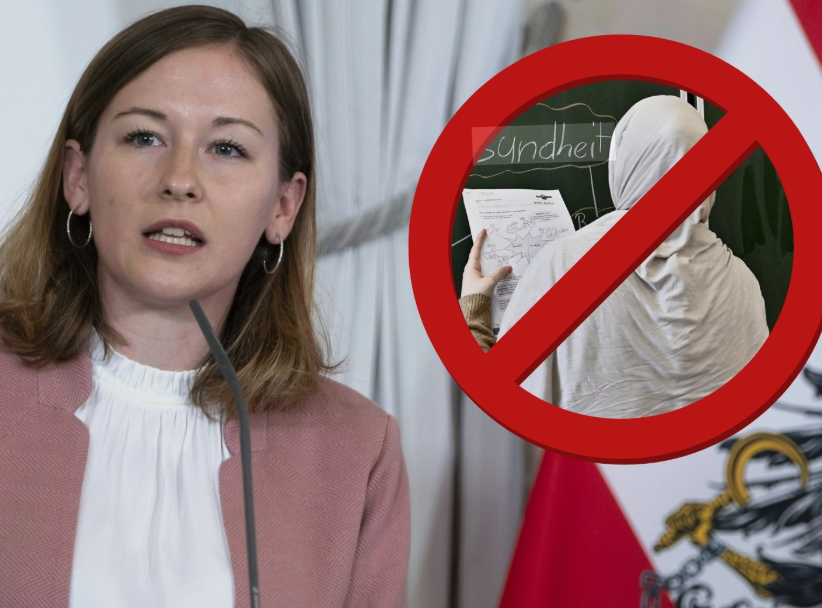
VIENNA, Dec. 11, 2025: Austria’s parliament passed a law on Thursday banning schoolgirls under the age of 14 from wearing a headscarf.
The coalition government, made up of the Austrian People’s Party (ÖVP), the Social Democratic Party (SPÖ) and Neos, said the new law represents a “clear commitment to gender equality” and applies to girls in both public and private schools.
Under the new law, all girls under 14 are forbidden from wearing what the government called “traditional Muslim” head coverings, which includes hijabs and burqas.
If any student is found to have violated the ban, they must enter into discussions with the school authorities and parents or legal guardians.
In the case of repeated violations, the youth welfare agency must be notified and families or responsible adults could be fined up to €800.
The government argued that the new law aims to empower girls and protect them “from oppression.”
Speaking ahead of the vote, the parliamentary leader of the liberal Neos party, Yannick Shetty said it was “not a measure against a religion. It is a measure to protect the freedom of girls in this country.”
He estimated the ban would affect about 12,000 minors in schools across Austria.
Critics say the legislation could fuel anti-Muslim sentiment in Austria and a similar proposal to ban head coverings for girls in 2020 was rejected by the Constitutional Court because it targeted Muslims.
But the opposition far-right Freedom Party of Austria (FPÖ), which voted in favour of the law, said it did not go far enough.
“There needs to be a general ban on headscarves in schools, political Islam has no place here,” FPÖ spokesperson Ricarda Berger said.
The Islamic Religious Community in Austria (IGGÖ) group argued the ban was a human rights violation and could split society.
IGGÖ said in a statement on its website it intended to review “the constitutionality of the law and take all necessary steps.”
A trial period for the new law is set to start in February next year with the ban going into force in September, when the school term starts.
A soft launch of the legislation will begin in February as the new rules are explained to educators, parents and children.Photograph: Ray Tang/Rex Features
Lawmakers in Austria have voted overwhelmingly to ban headscarves in schools for girls under the age of 14, despite concerns the legislation will deepen societal divisions and marginalise Muslims. The law could also be struck down by the country’s constitutional court.
The ban was proposed earlier this year by Austria’s conservative-led government, which took office in March after a far-right party came first in the elections but failed to form a government.
Before Thursday’s vote, Yannick Shetty, the parliamentary leader of the liberal Neos, the most junior party in the ruling coalition, defended the ban. He told the lower house: “This is not about restricting freedom, but about protecting the freedom of girls up to 14.
“It [the headscarf] is not just an item of clothing. It serves, particularly with minors, to shield girls from the male gaze. It sexualises girls,” he said.
The ban is expected to take effect at the start of the new school year in September, with families facing fines of up to €800 (£700) for repeated non-compliance. A soft launch of the legislation will begin in February as the new rules are explained to educators, parents and children.
Thursday’s legislation marks the second time that a government led by the centre-right People’s party (ÖVP) has set its sights on the headscarf. In 2019, as part of a coalition that included the far right, Austria introduced a ban on headscarves for girls under 10 years of age. The legislation was later overturned by the country’s constitutional court, which described it as discriminatory in that it specifically targeted Muslims.
This time around, the government said it had worked to avoid the same outcome. Shetty recently told reporters: “Will it pass muster with the constitutional court? I don’t know. We have done our best.”
Despite the uncertainty, lawmakers backed the ban by a large majority. The only party to oppose it was the opposition Green party, which argued that the law was unconstitutional.
In the lead-up to the vote, the bill was criticised by rights organisations, including Amnesty International, which said it would “not empower girls – on the contrary, it will add to the current racist climate towards Muslims”.
The official Islamic Community in Austria, the IGGÖ, said the ban would leave children “stigmatised and marginalised”. In a statement on its website, the IGGÖ added: “This is symbolic politics at the expense of those affected.”
Angelika Atzinger of the Amazone women’s rights association, said the ban “sends girls the message that decisions are being made about their bodies and that this is legitimate”.
Others pointed to the broader picture. Farid Hafez, a senior researcher at Georgetown University, suggested the debate was being used strategically to distract from Austria’s severe economic pressures, including a budget deficit of 4.7% of GDP. “In this context, debate over the hijab offers a convenient way to divert attention from deeper fiscal problems,” he wrote earlier this year.
While legal scholars have questioned whether the ban will hold up in court, Hafez noted that even if it were struck down, the damage had been done. “It sends a chilling message to young Muslim girls and boys: that their faith, and by extension their identity, is unwelcome in Austrian society.
“Austria’s fixation on legislating against the hijab is not about safeguarding children but about entrenching exclusion, normalising Islamophobia as mainstream politics, and signalling to a new generation of Muslims that their place in Austrian society will always be precarious.”