

ECAS NEWS, Jan 04, 2026:
1. What is Bill C-9?
Bill C-9 is a federal bill introduced in the 45th Parliament of Canada known as the Combatting Hate Act. Its objective is to amend the Criminal Code to strengthen legal protections against hate-related harms by introducing new offences and clarifying existing ones. The key provisions include:
a. New Criminal Offences
• Intimidation offence: Criminalizes conduct intended to provoke fear to stop someone from accessing buildings primarily used for religious worship, community centres, or other spaces used by an “identifiable group.”
• Obstruction offence: Makes it illegal to intentionally block or interfere with lawful access to the same kinds of places.
• Hate-motivated crime offence: Establishes a specific hate crime offence for existing and newly defined crimes motivated by hatred.
• Hate propaganda offence expansion: Adds a new hate-propaganda offence that makes it illegal to wilfully promote hatred against an identifiable group by publicly displaying certain hate or terrorism-related symbols.
• Definition of “hatred”: Bill C-9 adds a statutory definition of “hatred” to the Criminal Code.
b. Removal of a Legal Safeguard
The bill removes the historical requirement that the Attorney General must consent before hate propaganda charges can be laid, meaning prosecutors could pursue these charges without that added oversight.
2. Why the Bill Is Controversial?
While the government states its aim is to reduce hate crimes and protect vulnerable communities, civil liberties advocates, faith groups, and some politicians have raised serious concerns:
a. Free Expression and Peaceful Protest
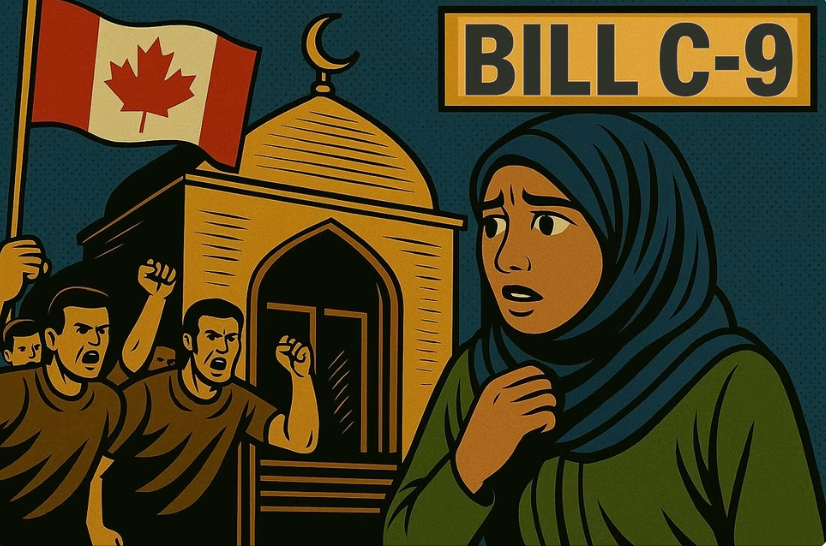
Critics argue the bill’s definitions and new offences are overly broad or vague, risking criminalization of protected speech and peaceful protest, especially around community spaces like mosques, churches, and cultural centres.
b. Loss of Safeguards
Removing Attorney General oversight could increase the risk of inconsistent or selective enforcement of hate-related charges, particularly against minority and equity-seeking groups that have historically faced disproportionate policing or criminalization.
c. Fear of Law Enforcement Overreach
Civil society groups and labour advocates warn that the expanded offences, especially intimidation and obstruction could be used against peaceful labour actions like strikes, protests, and community demonstrations.
d. Government Consultation
Some faith and cultural organizations have criticized the government for not adequately consulting communities affected by hate itself, including Muslim communities.
3. How Bill C-9 Could Affect Minority Communities (Including Muslims)
a. Religious Freedom and Expression
Minority faith communities — including Muslims — might worry that legal definitions and enforcement of hate-related provisions could be interpreted in ways that affect legitimate religious expression or cultural speech. The removal of the “religious text defence” during committee review has been criticized as weakening safeguards for good-faith expression of religious belief.
b. Criminalization of Peaceful Activity
Because the intimidation and obstruction offences cover conduct intended to deter access to religious or cultural sites, there is concern that legitimate protests, vigils or demonstrations by minority communities — for example around issues important to those communities — might be at risk of criminal charges if law enforcement interprets behaviour as obstruction or intimidation.
c. Selective or Disproportionate Enforcement
Historically in Canada, racialized and religious minorities — including Muslim, Black, and Indigenous communities — have faced disproportionate policing and criminal-justice contact. Without strong safeguards, broad offences could be enforced in ways that disproportionately impact these communities.
d. Consultation and Trust
In the case of Muslim organizations such as the Muslim Association of Canada (MAC), there is expressed concern that the lack of meaningful consultation undermines trust and raises the risk that the law doesn’t reflect the needs or realities of Muslim Canadians.
4. Supporting Intent: Addressing Hate Crimes
Proponents of the legislation argue it will strengthen legal tools to more explicitly address hate-motivated violence and intimidation against racial, religious, and culturally identifiable groups including those who have been targets of antisemitism, Islamophobia, racism, and other forms of hate. Government statements frame it as protecting Canadians of all backgrounds.
5. Current Status of the Bill C-9 (as of Early 2026)
Debate on Bill C-9 was ongoing as Parliament reconvened; at times, committee review paused and discussions continued into early 2026. No final enactment had occurred yet.